
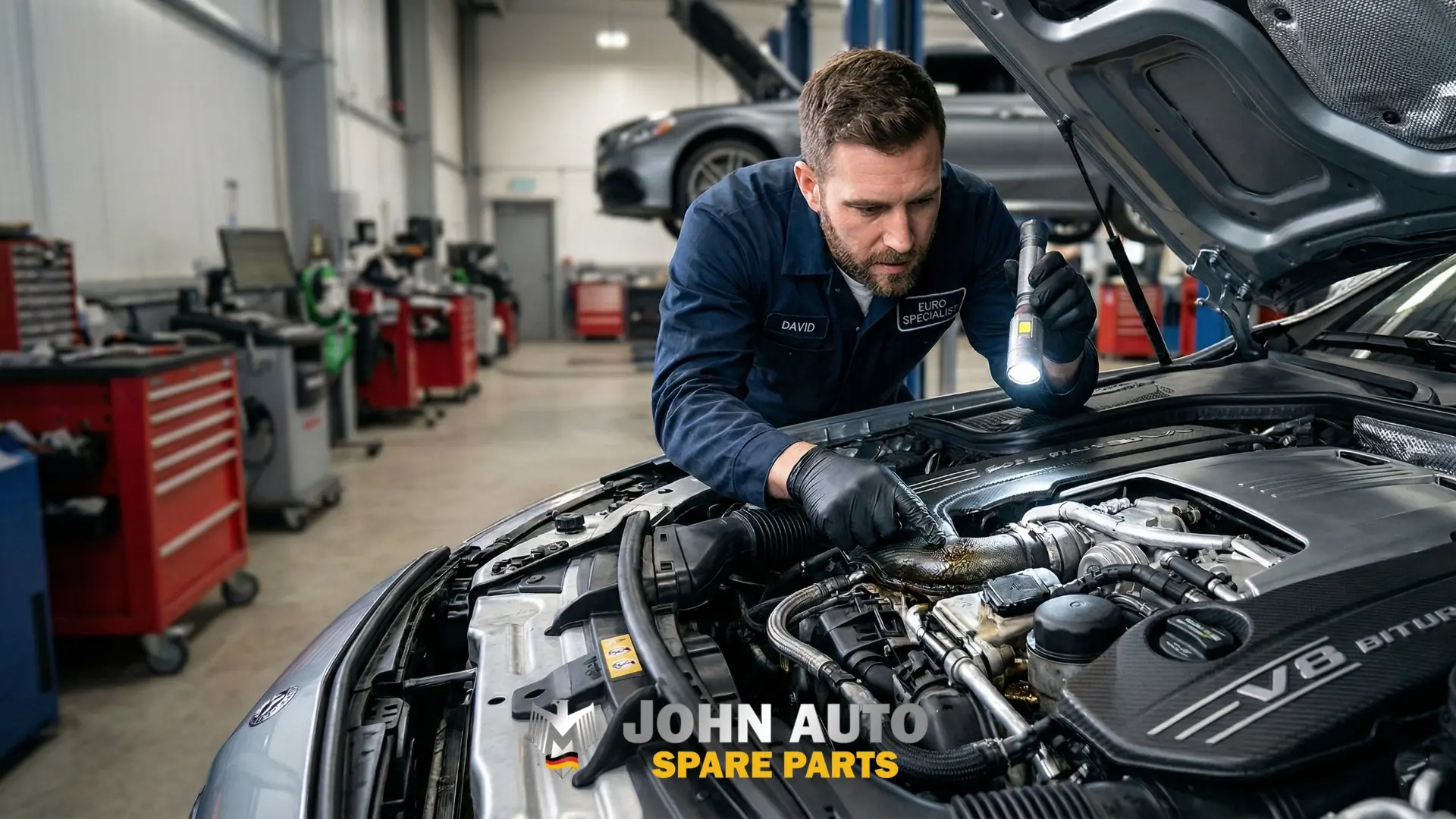
Oil Leaks on European Cars are one of the most common and frustrating problems owners of BMW, Audi, Volkswagen, Mercedes-Benz, and Porsche vehicles face. While these cars are known for performance, precision, and comfort, they are also notorious for developing leaks from aging gaskets, seals, and crankcase ventilation components. The good news is that most of these leaks follow familiar patterns, and once you know where to look and what to replace, you can fix them properly the first time and avoid paying for the same labor twice.
If you own a BMW, Audi, Volkswagen, Mercedes-Benz, or Porsche, you already know the frustration. You spot oil on the driveway, smell burning oil at stoplights, or see grime building up around the engine bay. The good news is this: most oil leaks follow predictable patterns. Once you understand where they start, why they happen, and what else should be replaced at the same time, you can fix them properly the first time instead of paying for the same labor twice.
This guide breaks down the most common oil leak causes on European cars, how to identify the leak zone, and the smart “while you’re in there” parts strategy that saves time, money, and headaches.

One of the most common leak points on European engines is the valve cover gasket. It sits high on the engine, sealing the valve cover to the cylinder head. Over time, that gasket is exposed to constant heat cycling—heating up, cooling down, and repeating that process thousands of times. Eventually, the rubber hardens, shrinks, and loses its ability to seal properly. Older gasket materials and aging rubber seals commonly become brittle and lose elasticity with age and heat exposure.
Typical signs include:
On many BMW and VW/Audi engines, the valve cover itself can also warp or crack, so it is important not to assume the gasket alone is always the problem. FCP Euro’s DIY content on BMW and VW applications also notes that valve cover and integrated PCV failures often show up together.
If you work around BMWs long enough, you start treating the oil filter housing gasket like a maintenance item. It is one of the most common oil leak sources on many BMW inline-6 and turbo engines, especially where the housing bolts directly to the cylinder head or block. FCP Euro specifically calls it one of the most common BMW leak sources on N5X-family engines.
Why it matters so much:
This is why many technicians do not treat an OFHG leak as a cosmetic issue. If neglected, it can turn into a much bigger repair. For a deeper model-specific reference, see FCP Euro’s BMW oil filter housing gasket article.
The rear main seal sits at the back of the engine where the crankshaft exits toward the transmission. When it leaks, oil often appears at the junction between the engine and gearbox. This is one of the more expensive leak repairs because access usually requires transmission removal, and on manual cars, oil contamination can even affect clutch operation. AA1Car notes that rear main seal repairs are time-consuming and often require separating the engine from the transmission or transaxle.
Common clues include:
Rear main seal leaks are the kind that tempt owners to “monitor it for now.” Sometimes that is understandable—but once it is apart, that is the moment to think ahead and replace related wear items.
This is the section many people overlook.
The PCV system—positive crankcase ventilation—controls pressure inside the engine. When it is working properly, blow-by gases are drawn out of the crankcase and routed back into the intake system. But when the PCV valve, oil separator, or breather assembly fails, crankcase pressure rises. And that excess pressure can push oil past seals and gaskets that might otherwise still be usable. AA1Car’s PCV explainer notes that pressure backup can force oil past gaskets and seals, while its oil leak guide also flags clogged PCV systems as a cause of crankcase pressure buildup and leaks. For a simple technical refresher, AA1Car’s PCV explainer is a good reference.
That is why replacing a leaking gasket without correcting a bad PCV system can lead to repeat leaks and comeback jobs.
Typical PCV-related symptoms:
Before replacing parts, you need to understand where the oil is starting—not just where it ends up.
A few practical clues:
Pro tip: Always clean the engine first before diagnosis. A dirty engine lies. A clean engine tells the truth.

This is where smart repairs separate professionals from parts-changers.
When a European engine is already disassembled, it often makes sense to replace adjacent seals, hoses, or wear parts that share the same labor path.
If the oil filter housing gasket is leaking, inspect the belt immediately. On BMWs especially, oil from the housing can run directly onto the serpentine belt. Dayco warns that belts contaminated with oil or other petroleum-based fluids can weaken, swell, and create noise, and that an oil-soaked serpentine belt should be replaced.
Replace together when needed:
This is one of the best examples of preventing repeat labor—and preventing a much bigger failure.
If the valve cover is coming off, do not think about the outer gasket only. On many European engines, it makes sense to service:
FCP Euro’s VW VR6 guide specifically notes that PCV failures are common and that replacing the gasket and PCV together saves time because the access is essentially the same.
Rear main seal jobs are labor-heavy because the transmission has to come out. That means this is the time to inspect or replace parts that share the same access path.
Smart “while you’re there” items may include:
Even if every one of those parts is not automatically replaced, this is the moment to evaluate them seriously. Paying the same labor twice later hurts far more than making the right call while access is already open. AA1Car notes the rear main seal job often requires major disassembly, which is exactly why combined service decisions matter here.
Oil leaks on European cars are frustrating—but they are rarely random. Most come down to a predictable list: aging gaskets, tired seals, and crankcase ventilation problems that were missed the first time.
The real key is not just replacing the leaking part. It is fixing the root cause, confirming the true leak zone, and following the “while you’re in there” rule so you do not pay for the same labor twice.
And when it comes time to order parts, this is not the place to gamble on the cheapest option you can find. OEM or high-quality OES parts usually offer better fit, better material quality, and better long-term sealing performance—especially on engines that run hot and have little tolerance for shortcuts.
Fix it once. Fix it cleanly. And fix the parts next to it that are most likely to fail next.
If you want, I can also turn this into a full SEO package with meta title, meta description, excerpt, tags, and social captions.
To get expert assistance and advice on the parts needed to save fuel, get in touch with our best sales advisor and discover the latest parts from John Auto Spare Parts.
John Auto Spare Parts (SHARJAH)
📍 King Faisal St., Industrial Area 1, Al Nahdha Sharjah, UAE
📞 Call or WhatsApp us at +971 6 532 6340
John Auto Spare Parts (DUBAI)
📍Warehouse 7 Street 3 – Al Qouz Ind.third – Al Quoz – Dubai, UAE
📞 Call or WhatsApp us at +971 4 236 0759
Prefer shopping online?
🛒 Visit our webshop at www.jasp.ae for fast browsing and secure checkout.